
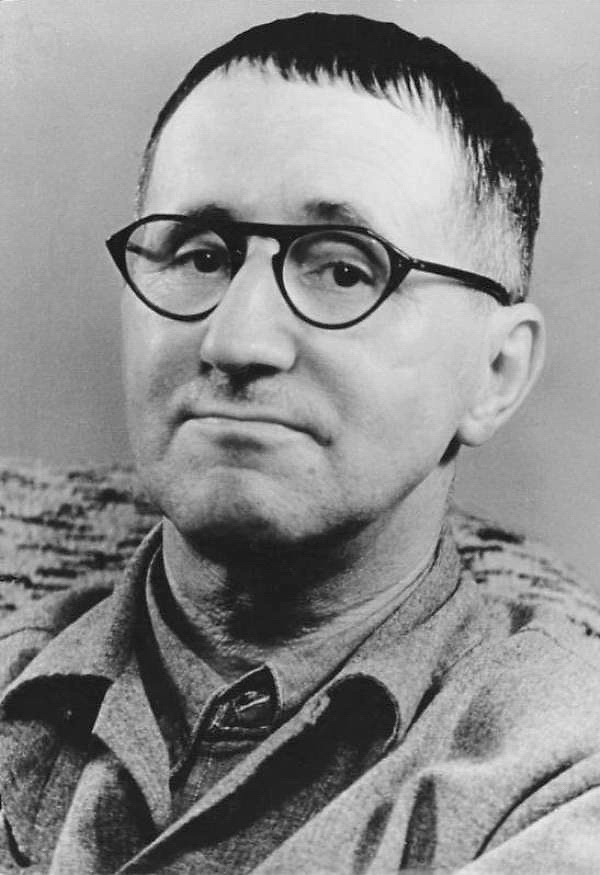
Brecht was born in Augsburg, Germany on February 19th, 1898. While he was in school, he co-founded and co-edited the school magazine. By the time he was 16, he wrote for the school news paper and wrote his first play about a girl and named it "The Bible". Brecht studied medicine and philosophy in the university of munich before working in the military hospital during world war I. The experience initiated his hate for war, which influenced him him to revolt, thus his fail attempt at the "socialist" revolution. After the war was over, he showed interest in literature more than medicine. He then produced a play called "Bael" and later was influenced by Ernst Toller thus dedicating his next plays on the influence of his work. In 1927 he started showing interest in musical plays, working with composers such as Kurt Weil and Hans Eisner. "Brecht attempted to develop a new approach to the the theatre. He tried to persuade his audiences to see the stage as a stage, actors as actors and not the traditional make-believe of the theatre. Brecht required detachment, not passion, from the observing audience. The purpose of the play was to awaken the spectators' minds so that he could communicate his version of the truth." (Spartacus Educational)Brecht's major influence in life was the war, music and the women in his life. After Brecht studied in medical school, he worked with military hospitals where he developed a hate for war which influenced him to stir a revolution, although it was a fail he then re-discovered an interest for literature. He was influenced by the work of Ernst Toller, and he was also inspired by music, thus his creation of musical plays in collaboration with Kurt Weil and Hand Eisner. In the last few remaining years of Brecht's life, he studied various languages which influences him as well as German playwrights.According to academic.evergreen.edu. there a few differences of epic theatre vs. dramatic theatre. The differences are shown in the opposing characteristics of both the types."Here are some characteristics of dramatic theatre:· Plotted· Suggestion· The spectator is in the middle of things and shares the experience with the audience· Unalterable human being· Growth· One scene makes another· Thinking determines being· They build up to an ending- which is the most important part" (academic.evergreen.edu)Now lets have a look at some characteristics of epic theatre:· It is completely scripted· The characters within the scene narrate and comment on the scene· The entire scene is like a build up in itself- there isn't any important ending.· Montage· The scene are one in itself, it isn't part of anything as a whole. So, its not that you have to watch every single scene to understand the "play" because each scene is a play itself.· Audience are allowed to exit in and out of the play, they can eat while they watch or leave for a coffee break, etc. It is not required for them to sit throughout the entire play because the have the freedom to enter and exit.Some visible impacts of Brecht's work in contemporary theatre include: masks and puppetry, use of technology in theatre (lighting, sound, etc), acting in third person, use of music, having actors describe what they're doing- outside of of the script- a narrator somewhat, signs or projections to give a prologue of what's going to happen in the forthcoming scene, also gestures were improved and used more variedly during acting. His practices greatly impacted theatre in all western country's.
Bibliography:
- "Biography of Bertolt Brecht (1898-1956)." Biography of Bertolt Brecht. N.p., n.d. Web. 21 Feb. 2014. <http://www.gradesaver.com/author/bertolt-brecht/>.
- "Bertolt Brecht." Spartacus Educational. N.p., n.d. Web. 22 Feb. 2014. <http://www.spartacus.schoolnet.co.uk/USAbrecht.htm>.
- "Bertolt Brecht ." Academic Evergreen . N.p., n.d. Web. 23 Feb. 2014. <http://academic.evergreen.edu/curricular/ppandp/PDFs/Brecht-a%20brief%20overview.pdf>.
Saturday, February 22, 2014
Unit 3: Epic Theatre (Bertolt Brecht) Study RESEARCH INVESTIGATION

Monday, January 27, 2014
Costume Renderings
 |
In this image, I have sketched a green dress with the signature bow in the bak that I have incorporated in most of the characters dresses to portray that they are apart of the same play. This dress particularly will be the same for Frances, Irma, Kathy and May in different colors. Orange for Irma, baby pink for Kathy and a royal blue for Irma. The dress itself is a solid color except for the apron, sleeve details and neck design. The apron is simply an orange silk material with black lace. That same material is on the sleeve as well as the neck. This dress should fluffed using a tulle lining. The black surrounding the neck however is the same colored orange material frilled around the neck with a muslin material. The swatches for this dress is down below: |

 |
This outfit for Eliza is very simple, elegant and youthful with the colors. The top portion is baby pink silk with with baby pink muslin ruffles around the neckline. The neck portion which remains empty is lace and the apron is the same baby pink lace with baby pink muslin ruffles. The bottom portion is a purple silk material with a tulle to fluff the underneath. This dress also incorporates the signature black bow in the back. Swatches down below: |

 |
| Dorothy has an interesting dress compared to the rest of the girls, the dress still incorporates the signature bow. The apron and sleeve of the dress is inspired by a late 1800s tablecloth and the dress itself is a baby pink silk. The dress should be lined with a tulle in order for an addition puff. |


Barbara's dress consists of youthful colors and an edgy yet playful design. The dress itself is made out of an orange silk material with a tulle lining for puff. The top portion and apron match, with a bow in the back. The neck is a scowl neck with buttons running down the bottom with the same orange silk material in the back.

 |
Rachel Brayton plays a girly quiet character throughout the script. For that reason being I have made her dress extra girly. The bottom portion is a picture of a baby pink silk material which is carried on the top portion as well. The top portion also incorporates a so to say half corset with should be made using a darker pink silk material and the buttons should be black. The apron is frilled with the same darker pink material and it has orange and baby pink shapes.  |
 |
This dress uses the similar material for the dress made for Rachel. The bottom portion is striped with purple and baby pink silk. The top has a purple corset with pink sleeves and baby pink top portion. The buttons are made out of the same darker pink silk used top frill the apron. The neck is a fitted turtle neck with a pink silk material. |


 |
  |


Thursday, January 23, 2014
Costume Reference from the Script
|
COSTUME Reference from Script
|
Page #
|
Research Task
|
|
|
1
|
“Small American
schoolyard – Massachusetts in about 1871/2.”
|
9
|
Find pictures and
descriptions of what kids would wear to school in this period.
|
|
2
|
“I had a blue dress on”
“You’re a bully Lizzie” “She’s got a boy’s name”
|
10, 18, 22
|
This suggests that
Lizzie isn’t a very girly character so I should find clothes that are simple
and perhaps tomboyish. (No frills and less draping)
|
|
3
|
“C’mon on lets play
ball”
|
14
|
Look at dresses that
are less dramatic perhaps a little casual.
|
|
4
|
“Costumes can
be kept simple. Girls will need a period apron or pinafore over a longish
dress or blouse and skirt. Boys can wear jeans and a suitable shirt. Although
originally played with an all-girl cast, the casting can be a combination of
boys and girls-though the parts of Lizzie and Rachel must be female”.
|
4
|
Research on aprons
during that time that match the dresses. Look at men’s shirts and pant flares
and how they tuck the shirts in.
|
Saturday, January 18, 2014
Costume Design Research
 |
Inspiration Board |
Above is a link to my inspiration page for costume design. I have researched and browsed through many costume designs and jewelry design throughout the 1880's. The style of clothing back then has made me absolutely obsessed. From the workmanship of the dresses to the style and class of it is absolutely addicting to look at. On my Pinterest I have pinned only a handful of images that are appropriate to incorporate for my costume designs for the girls in the Lizzie Borden play. I selected dresses that I considered appropriate for the age of the girls as well as aspects of dresses that I could possibly incorporate in my dress designs. I pinned a few absolutely stunning jewelry pieces because I think that they will be perfect buttons or accessory pins on the dresses to spice things up a notch. I also pinned this very unique oyster plate that will be a great print for the top or bottom of any dress or apron. Everything I have pinned will be used in at least one of my costume designs.
http://www.uvm.edu/landscape/dating/clothing_and_hair/1880s_clothing_women.php
^The link above has really helped polish my knowledge about fashion in 1880. The draping, pleating and fold really brought upon a fresh look. This website summarized how the sleeves and skirts were worn back then. Starting from different cuts and materials.
Friday, December 13, 2013
Costume Design
Characters chosen: Rachel and Lizzie Borden
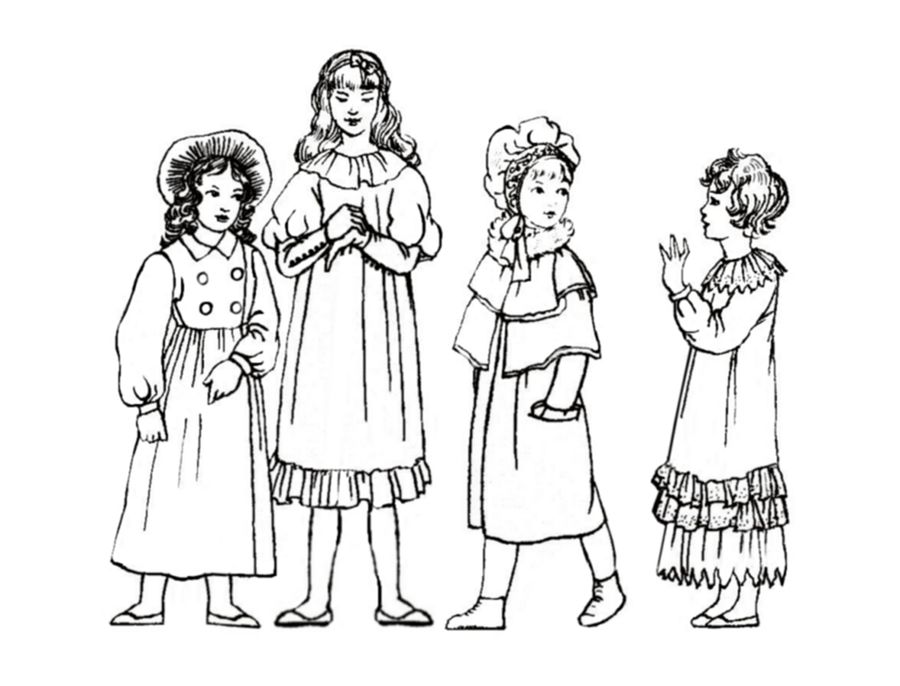
Stage 1: Rachel seems like an innocent character who is attached to her doll, so probably young in age, around 8 or 9. I don't think her social standard is too high, so middle class. Lizzie Borden on the other hand is opposite of innocent. Her social standard is high because a lot of people know her for her mistakes but that doesn't necessarily mean she's liked. Her personality seems a little goth, often emotional and angry. Some images that can inspire me:


Stage 2: Rachel's dress looks sweet and innocent and little girl like. It also has a pouch in her apron to store her beloved doll. Lizzie Borden's dress however is completely black and has an edgy touch to it like Lizzie is herself.


Stage 1: Rachel seems like an innocent character who is attached to her doll, so probably young in age, around 8 or 9. I don't think her social standard is too high, so middle class. Lizzie Borden on the other hand is opposite of innocent. Her social standard is high because a lot of people know her for her mistakes but that doesn't necessarily mean she's liked. Her personality seems a little goth, often emotional and angry. Some images that can inspire me:


Stage 3:


Subscribe to:
Posts (Atom)