Sunday, May 4, 2014

Unit 4: Blogologues - Task 1 - Research

Who? Allison Goldberg and Jen Jamula- graduates from Yale- are the co- creators of blogologues, as well as co-creative directors of lively productions.

What? According to Lively productions, they describe themselves as “a live sketch comedy show in which the internet is performed verbatim onstage” Basically the group transforms pre-existing online blog post into full performance pieces, with the blog being the base of the plot or even their entire script. Lively productions is known to “bring the internet to life”

Where? New York City/ Lower Manhattan- they performed their first show at Under St. Marks

When? Spring 2011, specifically May 2011, when they had their first performance about a blog on sex, drugs and interwebs.

Why? They were unable to join a preexisting theatre group, so they started their own and came up with new endeavors related to theatre.

The group’s performance concept is to literally bring the internet to life, by using content pre-existing on the world wide web that are related to different themes such as sex, money and literally anything. The theatrical tradition Thematic is used in their performances.


The processes in which the group has to undertake to create new performances should include:
-Surfing the Internet for content that has potential to fall under a theme
-Choosing a theme
-Finding content (blogs) on the theme.
-Ask for blog creators for permission to use their content/ blog as a performance piece.
-Brainstorm possible character ideas/ staging ideas
-Read out the blog as it is, attempting to make it as funny as possible.


According to my research, the typical most important element of blogologues is comedy. All their performances are somewhat funny, and has a realistic feel to it in an unusual way. Because the blogs itself are written by human beings so it isn’t meant to be anything out of the ordinary. However, they are performed in such exaggeration that it is funny and unusual.

As found in critic reviews, the positives of their performance are: 
“This is a great, intelligent, funny show.” –The Daily Beast
“While the theme changes every time, the topics are always up to date and often totally off the wall. Plastic surgery addicted Singaporean bloggers? Crazy mothers entering their daughters in child beauty pageants? Security guards at Sea World in, ahem, love with the the wildlife? It's all here, with the bonus of knowing that someone actually posted the material (usually in complete seriousness) on the internet!” –Blogologues reviewer on trip advisor.
Mostly the viewers are constantly watching these performances because of how fresh and up to date they are. Internet is the most commonly used tool to this day and watching the internet literally come to life through a performance is a very interesting and fun concept.  

Works cited: 

Sunday, April 27, 2014

Unit 3: Epic Theatre (Bertolt Brecht) Study: Final Performance Evaluation

Part 1: The task overall was one that my group didn't have a problem with. Although the task itself was fairly easy going, there were elements of epic theatre that we had to include and we had restrictions as to what we could do we the script. Deciding the basic theme/ story of the play was simple as Bangladesh has a variety of important issues that needs awareness and issues that are of concern to everyone of our community. As we chose an issue that is associated with a lot of emotion, a challenge that we had as a group is to combat that emotion in our script writing, as well as conveying the dialogues. It was especially challenging for me as I was the victim in the scene. I had to look startled but at the same time not expose any emotion in my dialogues as that is against an element in epic theatre. 

Part 2: I would grade myself a 6 out of 8 for personal engagement. I think I showed good commitment throughout the task, and I didn't have to be asked several times to get on with the work, and I very often made suggestions to our group. My major contribution to the group was the montage. Personally, i'm not much of an animal person or someone who sympathizes with animal cruelty or issues of such, however when creating the montage I was very awed by the images I found online of animal cruelty. I decided that thats the subject I wanted to go with for the montage as the emotions of both situations related almost perfectly. I chose images that weren't exactly disturbing to look at, but images that portrayed Mina's emotional state because of the rape and abuse. I would score Mifrah a 7 out of 8 for personal engagement, I think she did a good job keeping us all motivated and she made the biggest contribution to our group- which was the script. She wrote the script on her own, taking suggestions from us and I think she combined our ideas and did an excellent job keeping it abrupt and straight to the point. I would score Shubham a 6 out of 8, he supported me throughout my contributions and he had a good level of commitment and motivation. 

Part 3: I would evaluate my group's final performance as an 8 out of 10. I think we were all able to elaborate on our idea/ theme and we interpreted it very well through our script by performing the dialogues effectively. During our performance, I personally thought we had a very good flow, which is the major thing that worked well. I definitely feel that our audience understood our issue and the importance and I am definite that they were able to relate it the society that we live in. Although most of our families are modern at the current state, there are still several families in Bangladesh where its normal to kick daughters of the house if they were raped and abused because the family looks down upon "impure" girls. I think we effectively created a performance of epic theatre because we included several elements that epic theatre contain. Some elements of epic theater include: not giving away everything to the audience in other words not spoon feeding them the story. Also, not using emotion while delivering the dialogues, and montage. I think these are the elements we portrayed in our scene effectively. 


Part 4: I decided to evaluate Ayat's group as there were lots of things I would change about it. I believe their group performed scene one from "The Caucasian Chalk Circle" text. First of all, their montage did not go because montage isn't meant to be an exact or similar portrayal of the situation instead it should be about a topic that isn't related but sends the same message as the story. Their images didn't really work with the text because it was being too direct and broad. I would grade them a 6 out of 10 for application because although they seemed to have tried they didn't really incorporate the elements of epic theatre effectively. Some of the characters portrayed too much emotion while delivering the dialogues which is something epic theatre is against as we don't want to "spoon feed" the audience. They were able to satisfactorily elaborate on the text and their skills were used  satisfactorily to the context of the scene, but it could however be better. I felt like I wasn't too engaged with the scene and that is something they could have improved upon. I also didn't understand their story, or the way they staged themselves. Although the idea is not to "spoon feed" the audience, its not to confuse the audience either, I was curious as to what the message was. So they couldn't effectively interpret a specific theme. 

Wednesday, March 5, 2014

Analysis of themes and important elements

Motherhood:


In Act 3, the complete beginning Grusha is walking with her child for "another 7 days". Walking for such an extent of time in the cold, we would expect the mother to give up the child however Grusha safely reaches her brother's house with Michael. In order for Michaels financial safety, Grusha agrees to marry a dying man "on paper". Grusha sticks with her child regardless of the trouble she is getting into with the Ironshirts. Grusha's humble act relates directly with Brecht's life, we can see that when Brecht's mother had cancer, she still took care of Brecht. 

Source: "The Caucasian Chalk Circle Summary and Analysis." The Caucasian Chalk Circle Study Guide : Summary and Analysis of Act Three. N.p., n.d. Web. 6 Mar. 2014. <http://www.gradesaver.com/the-caucasian-chalk-circle/study-guide/section4/>.

Saturday, February 22, 2014

Unit 3: Epic Theatre (Bertolt Brecht) Study RESEARCH INVESTIGATION


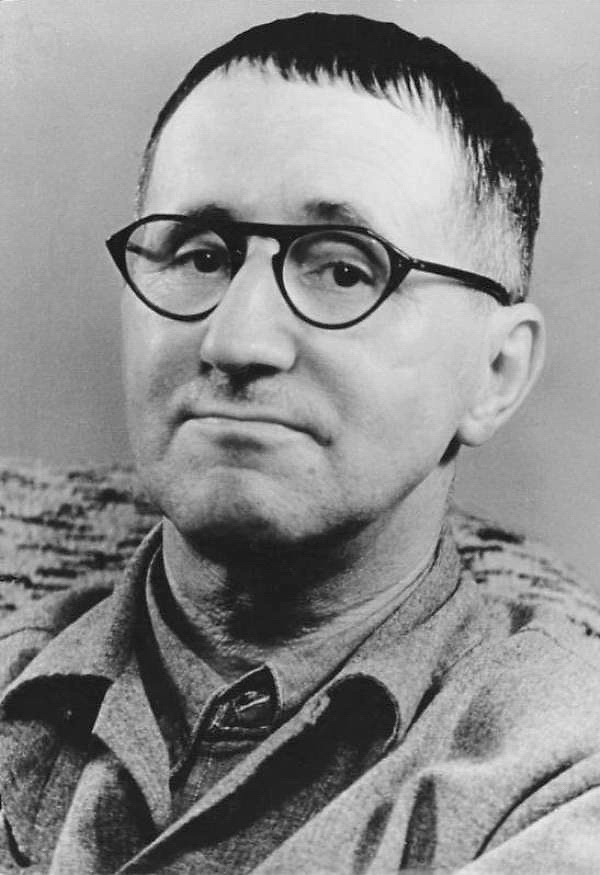
Brecht was born in Augsburg, Germany on February 19th, 1898. While he was in school, he co-founded and co-edited the school magazine.  By the time he was 16, he wrote for the school news paper and wrote his first play about a girl and named it "The Bible". Brecht studied medicine and philosophy in the university of munich before working in the military hospital during world war I. The experience initiated his hate for war, which influenced him him to revolt, thus his fail attempt at the "socialist" revolution. After the war was over, he showed interest in literature more than medicine. He then produced a play called "Bael" and later was influenced by  Ernst Toller thus dedicating his next plays on the influence of his work. In 1927 he started showing interest in musical plays, working with composers such as Kurt Weil and Hans Eisner. "Brecht attempted to develop a new approach to the the theatre. He tried to persuade his audiences to see the stage as a stage, actors as actors and not the traditional make-believe of the theatre. Brecht required detachment, not passion, from the observing audience. The purpose of the play was to awaken the spectators' minds so that he could communicate his version of the truth." (Spartacus Educational) 
Brecht's major influence in life was the war, music and the women in his life. After Brecht studied in medical school, he worked with military hospitals where he developed a hate for war which influenced him to stir a revolution, although it was a fail he then re-discovered an interest for literature. He was influenced by the work of Ernst Toller, and he was also inspired by music, thus his creation of musical plays in collaboration with Kurt Weil and Hand Eisner. In the last few remaining years of Brecht's life, he studied various languages which influences him as well as German playwrights. 
According to academic.evergreen.edu. there a few differences of epic theatre vs. dramatic theatre. The differences are shown in the opposing characteristics of both the types. 
"Here are some characteristics of dramatic theatre: 
·       Plotted
·       Suggestion 
·       The spectator is in the middle of things and shares the experience with the audience
·       Unalterable human being
·       Growth  
·       One scene makes another
·       Thinking determines being  
·       They build up to an ending- which is the most important part" (academic.evergreen.edu)

 Now lets have a look at some characteristics of epic theatre: 
·       It is completely scripted 
·       The characters within the scene narrate and comment on the scene 
·       The entire scene is like a build up in itself- there isn't any important ending. 
·       Montage 
·       The scene are one in itself, it isn't part of anything as a whole. So, its not that you have to watch every single scene to understand the "play" because each scene is a play itself. 
·       Audience are allowed to exit in and out of the play, they can eat while they watch or leave for a coffee break, etc. It is not required for them to sit throughout the entire play because the have the freedom to enter and exit. 

Some visible impacts of Brecht's work in contemporary theatre include: masks and puppetry, use of technology in theatre (lighting, sound, etc), acting in third person, use of music, having actors describe what they're doing- outside of of the script- a narrator somewhat, signs or projections to give a prologue of what's going to happen in the forthcoming scene, also gestures were improved and used more variedly during acting. His practices greatly impacted theatre in all western country's. 

Bibliography